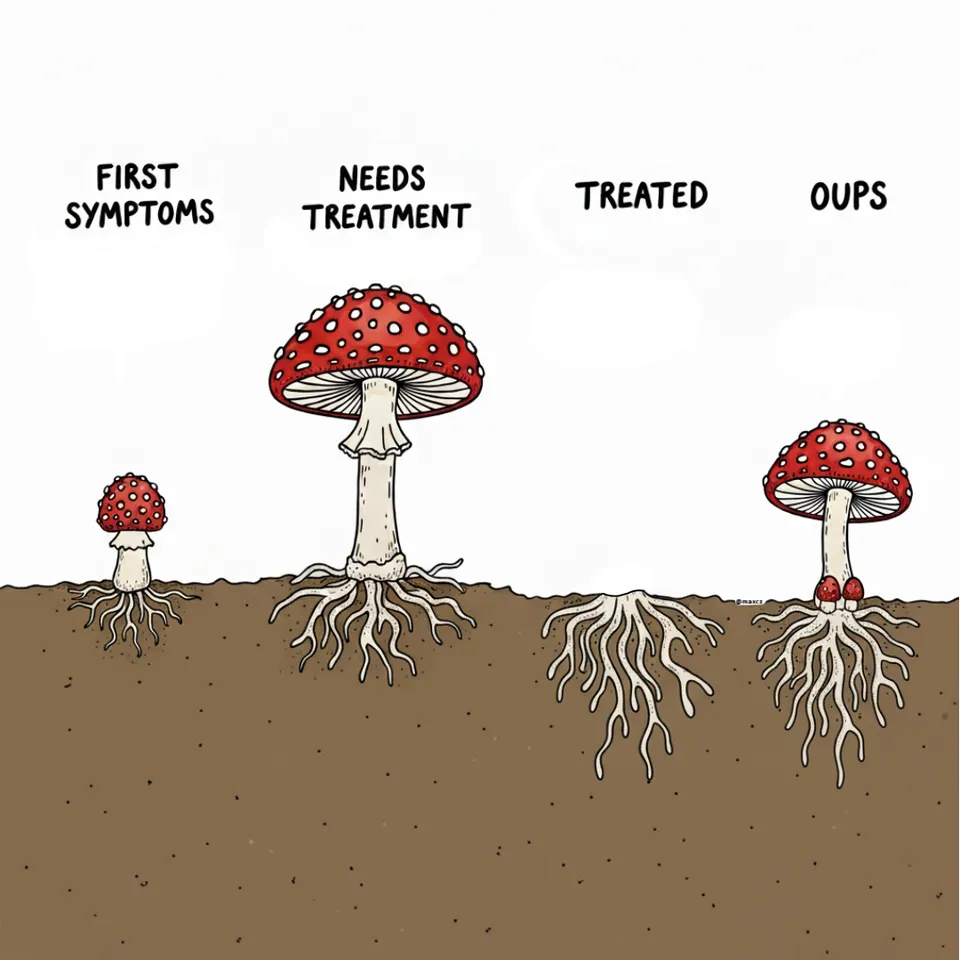
Treat the pain AND fix the cause
Inspiration/Source: Personal experience
Most Western-trained clinicians are great at identifying and treating what is right in front of them.
The harder question that is often left aside is: “Why did this start? What caused it?”
For simple problems, the standard path works.
You get injured / sick → you see a doctor → they prescribe a treatment.
That sequence often helps for straightforward injuries or illnesses.
But for more complex ones, two big points are missing:
- Root-cause thinking. Many Western-trained clinicians focus on treating the painful spot and forget to ask what is upstream. A holistic view is often missing.
- Feedback loops. If treatments “work,” many patients do not come back to debrief. That means clinicians often do not know whether the treatment helped, merely quieted symptoms for a while, or did not work at all.
Take a hip injury: is it a hip problem, or is the hip compensating for an imbalance somewhere else?
Which raises a useful question: is this clinician the best person to assess it, or should they bring in someone who sees a different part of the picture?
When care is not holistic, the pain might improve, but if the reason it started lingers, the symptoms will return sooner or later.
Experiencing it firsthand
In my early 20s, my knees started to ache regularly.
Diagnosis: patellar tendinopathy. I saw multiple doctors. The standard options came up: surgery or shockwaves.
I chose shockwaves (a device that sends pulses; it feels like a tiny hammer on the injured area). The goal is to increase blood flow and, in turn, healing. Maybe it helped the tissue, but the symptoms kept coming back.
Like many tendinopathies, it hurt, but I could still train. So I did.
One coach finally asked, “Why not get an X-ray of your legs and check alignment?”
After trying everything from acupuncture to supplements, I figured: why not.
Result: a 1.2 cm leg-length difference. My hips and spine had been compensating, creating a chain of imbalances that landed in my knees. Plenty of people have small differences and never notice. In my case, intense sport made it show up.
With that information, an orthopedist made custom insoles, which helped a lot. But the full fix was not a single device; it was addressing the cause and pairing it with strength work around the knees and hips.
Without that wider view, I might have gone through surgeries that healed tissue, but the root cause would not have been fixed. The problem would have kept coming back.
Be curious with your care
Pain on its own is only the surface. Bodies are systems, and systems rarely fail in just one place. Care works best when it looks beyond the sore spot and considers context and the body in its entirety.
Medicine is invaluable, yet no clinician sees everything. Listen to your doctors, and also keep a clear head. Do not accept any plan as the whole story simply because an expert proposed it.
The aim is not distrust, it is discernment. Hold space for expertise and for your own observation of patterns over time. That balance is what turns short-term relief into lasting progress.
This is a personal story, not medical advice. Always work with a qualified professional for diagnosis and treatment.